
Anyone can show you a number.
The useful question is whether you can check it. Every figure in an InternetWRX report resolves to a database record you can open, and the claims that cannot clear that bar do not get sent.
Three classes, and only one of them counts.
Every piece of evidence is filed as measured, correlated or inferred when it is recorded. The class decides what language is allowed around it.
Measured
Observed directly from a source that reports it.
"Three new Google reviews. Rating steady at 4.7."
May move the score. May be stated plainly.
Correlated
Two things happened in the same window.
"A competitor published a location page in the same week they overtook you."
May be reported. Must be hedged. May never move the score.
Inferred
A conclusion drawn from evidence rather than read off it.
"The new page appears to be a possible contributor."
May be offered as a possibility. Never as a cause, and never scored.
The rule that only measured evidence may move the score is not a guideline that a future change could quietly break. It is a constraint on the database table itself, so a row carrying any other class is rejected at write time.
A second model checks the wording.
Before anything reaches you, a separate model on a different vendor reads the draft and checks it: does every number resolve to a record, does the language match the evidence class, is the data fresh enough, is coverage sufficient to make the claim at all.
A different vendor on purpose. A model checking its own output shares its own blind spots, and the check becomes decorative. Failures go back for rewriting. They are never quietly let through.
On the demo account the checker currently passes six conclusions and rejects two: one for claiming cause where only correlation exists, one for making a claim the data coverage does not support. Both rejections stay on the record, with their reasons, so the decision is inspectable.
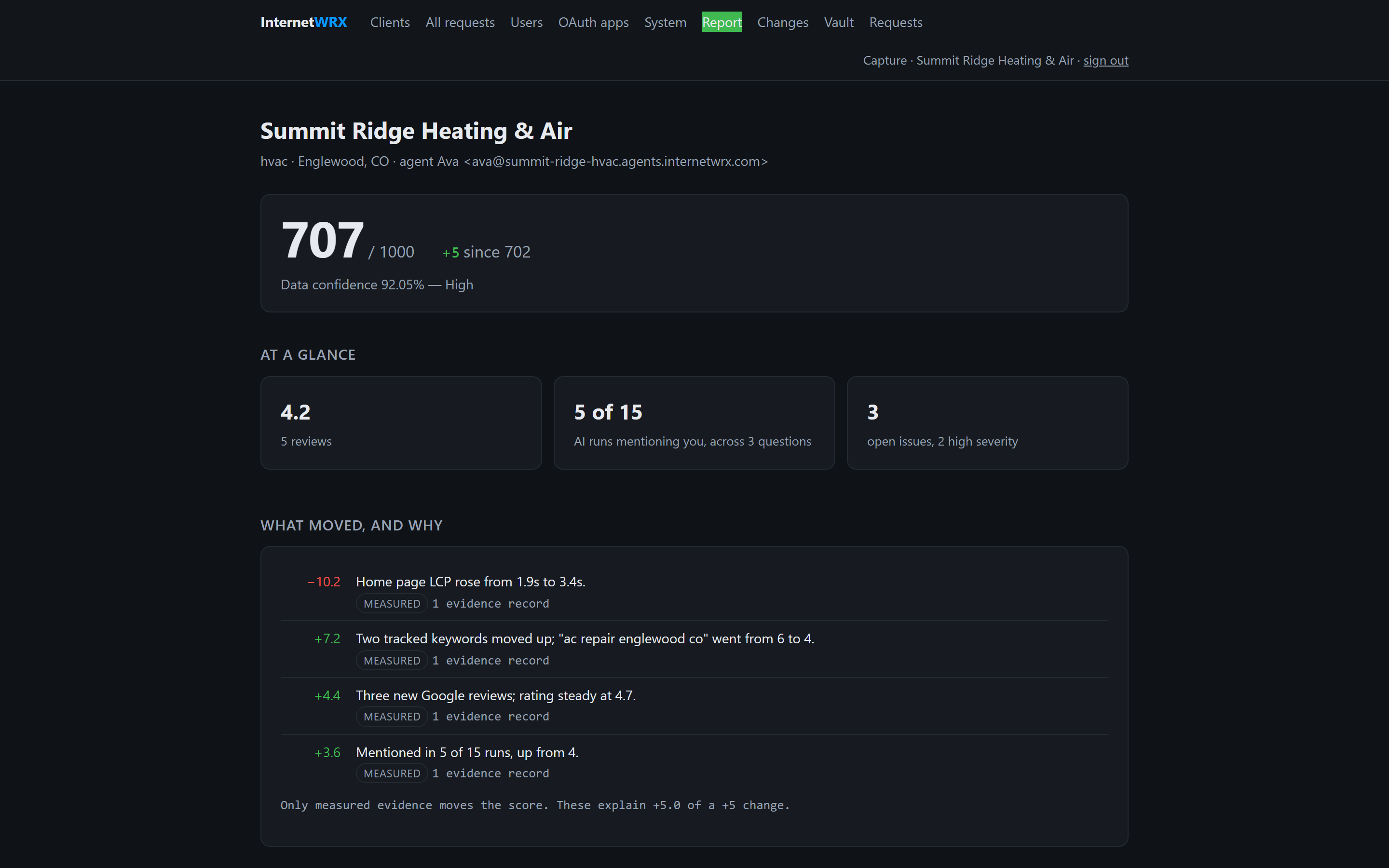
What a report actually looks like.
Statements from the demo account, with the class each one was filed under and the number of records behind it.
- Two tracked keywords moved up. "ac repair englewood co" went from 6 to 4.measured2 records
- Three new Google reviews. Rating steady at 4.7.measured3 records
- Home page largest contentful paint rose from 1.9s to 3.4s.measured1 record
- Mentioned in 5 of 15 assistant runs, up from 4.measured15 records
- A competitor published a location page in the same week they overtook you.correlated4 records
Those four measured changes sum to the score movement exactly, with no residual. If they did not, the difference would be shown rather than hidden.
The floors it will not cross.
Each of these is a place where the honest answer is nothing, and where every competing product shows you a number anyway.
Below 40% data confidence
The score is computed and then withheld. What is measured is still shown, and the gap is named.
What would close it: Connect the sources behind the missing components.
Under 50 comparable businesses
No percentile, no comparison band. A ranking drawn from a handful of accounts reads as authoritative and carries no information.
What would close it: Scale. This one is honest about being a long way off.
Under three months of history
No trend line. Two points make a line whether or not there is a trend, and a move inside the measurement band is not a move.
What would close it: Time, and nothing else.
None of this is a feature anyone asked for. It exists because the alternative is a report that cannot be checked, which is what the industry already sells and what most owners have stopped believing.
Request an audit